
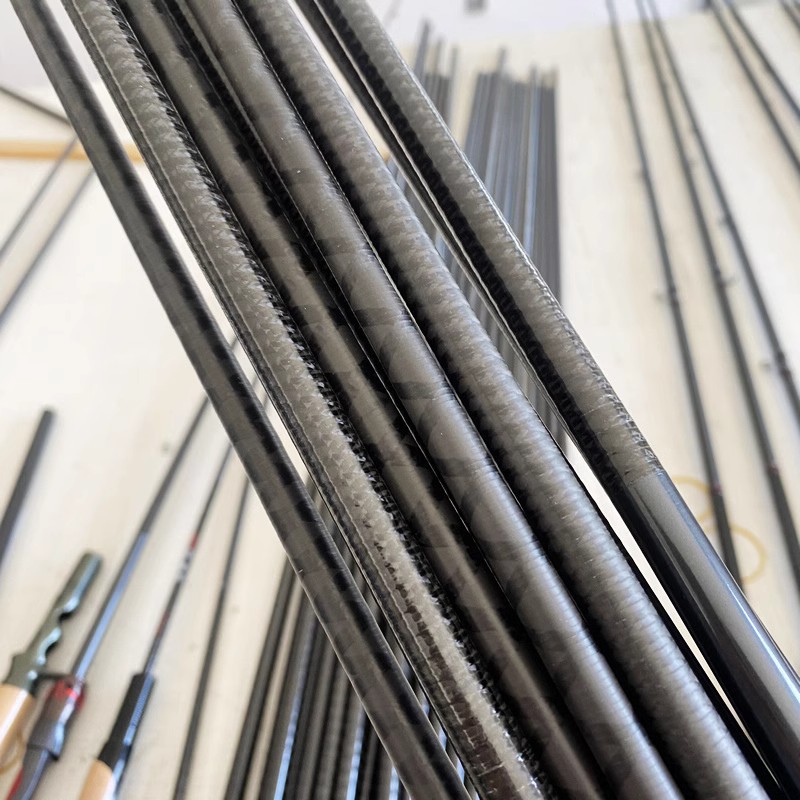
Why Rod Softening Happens
Many anglers notice that their fishing rods become softer after some time, but few understand the real reason behind it. This softening is not just about the carbon fiber—it’s primarily related to how the resin (glue) is used and processed during rod manufacturing.
The Role of Resin in Carbon Fiber Rods
A fishing rod blank is made of two main components: carbon fiber and resin.
Carbon fiber provides the rod’s strength and stiffness.
Resin bonds the fibers together, forming a solid, tubular structure.
Without proper resin application, even high-quality carbon fiber cannot perform optimally. Uneven resin distribution can lead to internal weak points, causing the rod to soften over time.
How Rod Manufacturing Affects Durability
From our experience, controlling the resin during the entire manufacturing process is critical:
1.Carbon fiber rolls are ordered from suppliers and pre-coated with resin.
2.They are shipped in cold-chain containers and stored in freezers at -30°C.
3.When ready for production, rods are thawed in a controlled environment (-5°C) and cut, rolled, and wound in a temperature- and humidity-controlled workshop.
Each step ensures that the resin remains in optimal condition. Improper handling or temperature fluctuations can reduce resin effectiveness, which may impact long-term rod performance.
Why Rods Become Softer
There are two main reasons for rod softening during use:
1.Air pockets in the rod blank
Tiny air bubbles can form during the rolling or curing process. With repeated bending, these bubbles expand, and carbon fibers may partially separate, reducing the effective strength.
2.Uneven resin distribution
If the resin does not penetrate every fiber layer thoroughly, the rod loses stiffness over time.
How to Prevent Softening
1.Proper tape tension and winding
Applying sufficient tension during wrapping helps push out air pockets and ensures the resin fills every part of the rod blank.
2.High-quality or nano-level resin
Finer molecular structure resins penetrate fibers better, maintaining performance for longer.
3.Controlled curing and temperature management
Ensuring consistent heat and humidity during curing maximizes bonding and durability.
4.Proper storage
Avoid exposing rods to high temperatures, which can accelerate resin aging and brittleness, weakening fiber bonds and causing rods to soften faster.
Conclusion
Rod softening is not an inevitable problem—it’s largely determined by how carbon fibers and resin are handled during manufacturing and storage. Understanding these details is essential for new fishing rod brands and manufacturers who want to produce durable, high-performance rods.
If you’re developing your own fishing rod brand, proper material selection, production techniques, and storage management can help you avoid common durability issues.
For a step-by-step guide on starting your own fishing rod brand, including prototype testing, small batch production, and material selection,contact us at https://fishingcrafter.com/product-category/fishing-rod/